Brought to you by Luxury Taj Tours
India's North East - the 'Seven Sisters' states of Assam, Meghalaya, Nagaland, Manipur, Mizoram, Tripura, and Arunachal Pradesh, plus the mountain kingdom of Sikkim - is the subcontinent's final frontier. Less visited than any other region, it rewards the curious traveller with living root bridges engineered by tribal communities over centuries, one-horned rhinos in arguably Asia's finest wildlife park, Himalayan monasteries perched above the clouds, and a biodiversity that makes the rest of India seem tame. This is India at its most extraordinary.

%2Fbw-travel%2Fmedia%2Fmedia_files%2F2025%2F04%2F23%2FestcZptxY3keOqsED55e.jpg&w=3840&q=75)
Meghalaya: The Abode of Clouds
Meghalaya is officially the wettest place on earth - and the moisture has shaped a landscape of extraordinary lushness. The Khasi tribe of the East Khasi Hills developed a unique bioengineering tradition: training the roots of rubber fig trees across rivers over decades - sometimes centuries - to form living root bridges that grow stronger each year. The double-decker living root bridge near Nongriat, reached by 3,500 steps through dense jungle, is one of the most remarkable natural-human constructions anywhere. Cherrapunji (Sohra) and Mawsynram, which compete for the wettest-place-on-earth title, offer dramatic gorge landscapes and extraordinary waterfalls. Shillong, the state capital, is the only hill station in Northeast India and has an energetic music scene.
- Nongriat living root bridge - double-decker, ~3 hours trek
- Mawlynnong - Asia's cleanest village, tree-house viewpoints
- Dawki - crystal-clear Umngot River, boat ride on glass-bottom water
- Cherrapunji - Seven Sisters Falls, Nohkalikai Falls viewpoint
- Shillong - 'Scotland of the East', vibrant music and café culture
Assam: Rhinos & Tea Estates
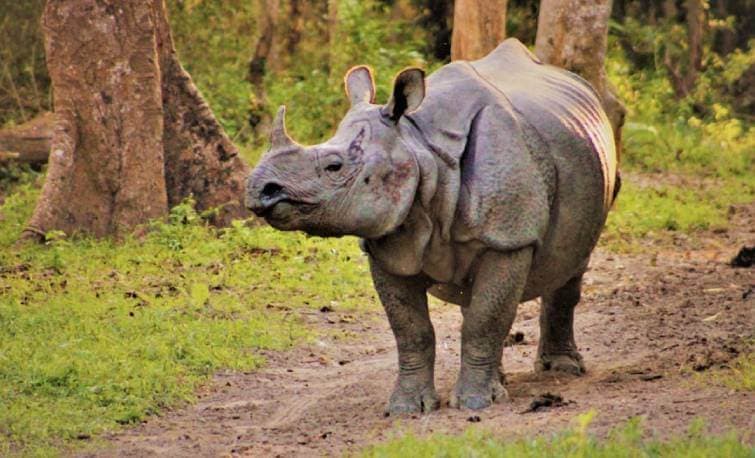
Assam is home to Kaziranga National Park - a UNESCO World Heritage Site hosting two-thirds of the world's remaining greater one-horned rhinoceros population, roughly 2,500 animals. Kaziranga also shelters the world's densest population of Bengal tigers, and its elephant herds are among the largest in Asia. The best way to experience the park is an early-morning jeep safari followed by an elephant-back ride into the tall elephant grass where rhinos graze. Beyond the wildlife, Assam's Brahmaputra Valley is blanketed in tea gardens - the world's largest tea-growing region. The town of Jorhat is the gateway to Upper Assam's most scenic estates, where river islands (chars) host unique tribal communities accessible only by boat.
- Kaziranga National Park - greatest one-horned rhino concentration on earth
- Elephant safari - into the tall grass at dawn
- Majuli Island - world's largest river island, Vaishnavite monasteries
- Assam tea estates - Jorhat, Dibrugarh; estate tours and tastings
- Kamakhya Temple, Guwahati - most important Shakti shrine in India
Sikkim: The Mountain Kingdom
Sikkim, the former Himalayan kingdom that joined India in 1975, is a jewel of biodiversity and culture compressed into a small mountain state. It borders Nepal, Tibet, and Bhutan, and its population is a unique blend of Nepali, Sikkimese (Bhutia), and Lepcha cultures - predominantly Buddhist. Gangtok, the graceful capital, sits at 1,650 metres with views of Kanchenjunga (8,586m), the world's third-highest peak. The Rumtek Monastery, one of Tibetan Buddhism's most sacred seats, houses priceless relics. Yumthang Valley - the 'Valley of Flowers' - in North Sikkim blazes with rhododendrons in April and May. Permits are required for many areas, adding to the sense of adventure.
- Gangtok - Rumtek Monastery, Nathu La Pass (4,310m, Tibet border)
- Yumthang Valley - rhododendron 'Valley of Flowers' in April–May
- Pelling - Pemayangtse Monastery, sunrise views of Kanchenjunga
- Tsomgo Lake - glacial lake at 3,753m, yak rides
- Namchi - Chardham replica complex, panoramic Himalayan views
Practical Information
We design bespoke Northeast India itineraries - from Meghalaya root bridge treks to Kaziranga safaris and Sikkim monastery circuits - typically 10 to 16 nights.